
Prepare and Prevent
Part Two: Get ready to testify


My original plan for Part Two was to explore more nuances of preparation and prevention using practical examples from cardiac surgery, because it’s the discipline I know best. Then, just as I was beginning to sink my expository plow to full depth, I was unexpectedly swept into another kind of preparation. A medical malpractice claim that had been lingering in the wings, appearing destined for dismissal or a trivial settlement, suddenly sprang to life. A jury was selected. The court calendar wiped out much of mine.
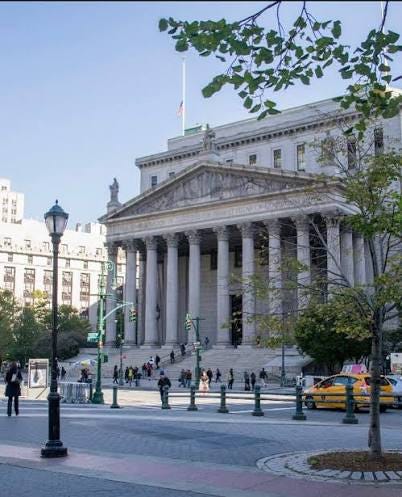
Among other things, this added to my daily commute the challenge of traversing the length of Manhattan during peak hours. On the first day my packed subway car on the A-train was shared with a menacing disturbed man who tried everyone’s nerves on the long rattle from 168th to Fulton. Back above ground it was a beautiful morning and a lovely walk past City Hall to the New York State Supreme Court Building at 60 Centre Street. Don Barzini tumbles down the building’s iconic front steps when assassinated in Godfather One. An incomplete list of other court-steps star-turns includes Goodfellas, Legal Eagles, Spider-Man 3, Joker: Folie a Deux, and 12 Angry Men. I survived the steps and passed through a fifteen-minute security line in time to hear opening statements and catch my breath before taking the stand. I was the first piñata for the plaintiff’s attorney, a privilege earned by being the sole named defendant (along with the hospital).
Among the broad generalities laid out in Part One, I said that preparation plants its flag in the present but is judged in the future. Preparation for trial involved reading thousands of pages of notes, tables, diagnostic studies, images, and data summaries from the inpatient records of three hospitals and outpatient records from seven doctor’s offices. I studied the transcripts of five depositions, including my own. My labor paled in comparison to that of my defense attorney and his associates, who studied every word in a mountain of hard copy, which they tediously labeled and cross-referenced for use as ammunition during the live-fire phase of the exercise.
Over many hours my defender guided me through the most important parts of this corpus page by page. Preparing me one-on-one was a small part of his preparation for trial, much of which depended on his ability to predict the live action to come. He knew the plaintiff’s attorney from previous battles, and he could sketch the outlines of likely plaintiff strategies from a combination of the pleadings, the kinds of experts hired by the plaintiff, affidavits from said experts, previous motions and countermotions, and settlements offered and rejected. My attorney had tried cases with our judge before, which helped him make informed guesses about how the line of scrimmage would be controlled. He led me through what the plaintiff’s attorney was likely to ask me during direct and cross-examination, and we rehearsed the best ways to answer, within the bounds of honesty. Our preparation applied prediction to reduce uncertainty: “This will not be an informed consent case,” my attorney predicted, with conviction. The plaintiff had made no claims regarding the consent process, so it felt like a safe bet that the plaintiff’s attorney would not go there with me, consequently we devoted very little prep time to that issue.
Back to the live action at 60 Centre Street, all my preparations were about to be tested right there in the witness chair. I solemnly swore, lowered my right hand, and adjusted the microphone. The bell rang, and off we went. The plaintiff’s attorney opened by eliciting some conventional recitation of my professional history and qualifications. With oily obsequiousness he praised the big-picture success of the open-heart operation I’d performed on the plaintiff. Then he pivoted…to the consent process! He read to the jury the part of the plaintiff’s deposition in which the plaintiff described what he remembered of his consent discussion with me. Standing in front of the jury box, arms to the sky, one hand brandishing the transcript, my interrogator vividly dramatized the shocking disconnect between that description and what I had claimed in my deposition was my “custom and practice.” He strolled to the overhead projector, slowly shaking his head in amazement, and exhibited multiple consent forms signed by the plaintiff for various procedures, highlighting in mine the absence in writing of the rare complication that was the basis of this malpractice action. And on and on he went, recapitulating his theme: “Doctor, why should the jury believe you said something important when you couldn’t be bothered to write it down?”
My analytical forebrain was still confident that this was a legal nothingburger, but I don’t think that was his point. Preparation by the plaintiff’s attorney might have included a prediction that my team would not prepare me for that nothingburger. If I reacted badly to something unanticipated the jury might wonder if this suddenly soggy, quivering, unconfident old man could possibly be the Great Surgeon they’d just heard about. And I might complete my own dismantling by getting disproportionately angry.
Truth be told—consider me still under oath—I know from experience how hard it is to suppress anger in that situation. No one enjoys answering questions that are specifically designed to make you look bad in front of an audience that has limited understanding of what you do every day, especially when constrained by “yes or no, Doctor!” The more trivial the allegations, the more of an imposition all the time and effort wasted on the entire process seems. And underneath my righteous anger are traces of guilt, when interrogatory scrutiny exposes the comfortable, expedient gaps in many of our routine processes. Why, indeed, do I not list specific risks and benefits in writing? My opponent delighted in exhibiting a consent from a plastic surgeon who routinely scribbles a handwritten list of potential risks on the form and has the patient initial the list.
Of course plastic surgeons do that, I aver, because they are so frequently sued over subjective disappointments! The plaintiff’s attorney has that little editorial stricken and the jury is instructed to disregard. Still, my opponent allows me to explain that the most common custom & practice is to use the printed, signed consent document to memorialize a detailed oral discussion of risks and benefits that takes place in some other setting, like the office or at the bedside, in which it’s impractical to write down every word on the actual form that’s eventually signed. I point out that consent forms are developed by hospital legal bureaucracy to cover the entire spectrum of procedures performed in the hospital. The consent boilerplate is specific only for the universals, just as Delta’s “important safety message” covers oxygen masks and seat belts but doesn’t cover issues that can only arise at LaGuardia. Furthermore, I pontificate, a general, pre-printed consent form that listed all possible complications of all possible procedures would look like those “Terms and Conditions” that no one reads when downloading a new app.
Sermonizing on many practical reasons for custom & practice surrounding the consent process chuffs me up, but will these nine peers of mine consider them justifications? My opponent counters, “Yes, Doctor, all very practical in the grand scheme of things, but in this setting—one patient being informed by one surgeon—should the jury not wonder why you couldn’t just make a list?” Volleys of sustained objections from my attorney are a clear reminder that my guilt or innocence will not turn on informed consent. But from my tormentor’s point of view, following the rule that 100% of the shots you don’t take don’t go in, he has nothing to lose by trying to crack my façade of lofty imperturbability. Conversely, as a defense strategy, an air of confident competence seasoned with just a pinch of prideful anger can be a good look. The jury will decide who won.
I was deep into my third hour on the stand before I dared sip water from the glass graciously placed next to me by the court officer. Try that stunt too soon, and your cover is blown when the jury sees a quivering hand, or even worse, the humiliating two-hand grip. The glass needs to glide slowly and smoothly from table to lips, sipped as if savoring, then slowly and smoothly replaced on the table. Over the course of the trial I enjoyed a measure of revenge watching my attorney subvert the three opposing experts, eviscerating the one revealed to be a specialist-for-hire who admitted to making millions of dollars testifying against doctors—in every state except Alaska and Hawaii. It must be said, however, that despite all my righteous anger at the process it is impossible to forget that there is a person at the center of it all. A person I know, sitting right over there, whose heart I’ve held in my hands, who is upset by the outcome; another deep rut in the road connecting impact to intent.
What does this have to do with Prepare & Prevent? Exhaustive preparation failed to eliminate all uncertainty; I was ambushed on consent. We can prevent the predictable, we can only prepare for the unpredictable. Should I have prepared generically for reacting to an annoying surprise, even if I couldn’t be sure what that surprise would be? In the moment I hope I was successful relying on instinct and cumulative experience to prevent being discredited when confronted with something unanticipated. Substitute “disabled” for “discredited” in that sentence and it describes a cornerstone of surgical performance, and one goal of the kind of preparation to which I will return in Part 3.
The informed consent process itself is a kind of preparation. The consent discussion prepares the patient for what might happen, both good and bad. The benefits and risks are often framed as quantitative statistical predictions. Both parties hope only the benefit part will later seem prophetic, and the risk part can be forgotten. But the patient who suffers a 1% complication might also have forgotten until it happens—or abstract awareness of a statistical probability may not have prepared him for how it would feel.
In the end, I prevailed. Acquitted sounds too strong. Found blameless comes closer but sidesteps the fact that a problem arose during my operation. Had I been blamed, large amounts of money would have changed hands. The defense’s investment in preparation would seem to have paid off. Suppose this case had settled just before I took the stand. Would all the time, energy, and expense devoted to preparation have been wasted? Or did I fill some sandbags I might be able to use against the next flood? Regardless, the plaintiff may still have pain.
Readers interested in a longer description of my first ordeal on the stand, many years ago, can read Nobility in Small Things (pages 190-194).